Ausstellung von Hannelore Fehse „Schwäbische Alb – Architektur und Landschaft“
Galerie Stepanek in Göppingen Faurndau
21.Oktober bis 27. November 2016
Einführung: Gerlinde Hühn, Dekanin i.R.
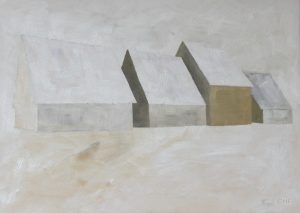 |
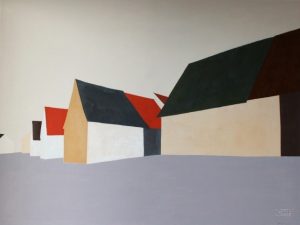 |
| Scharenstetten Winter | Merklingen |
In dieser Ausstellung sehen wir verschiedene Aspekte des Werkes von Hannelore Fehse:
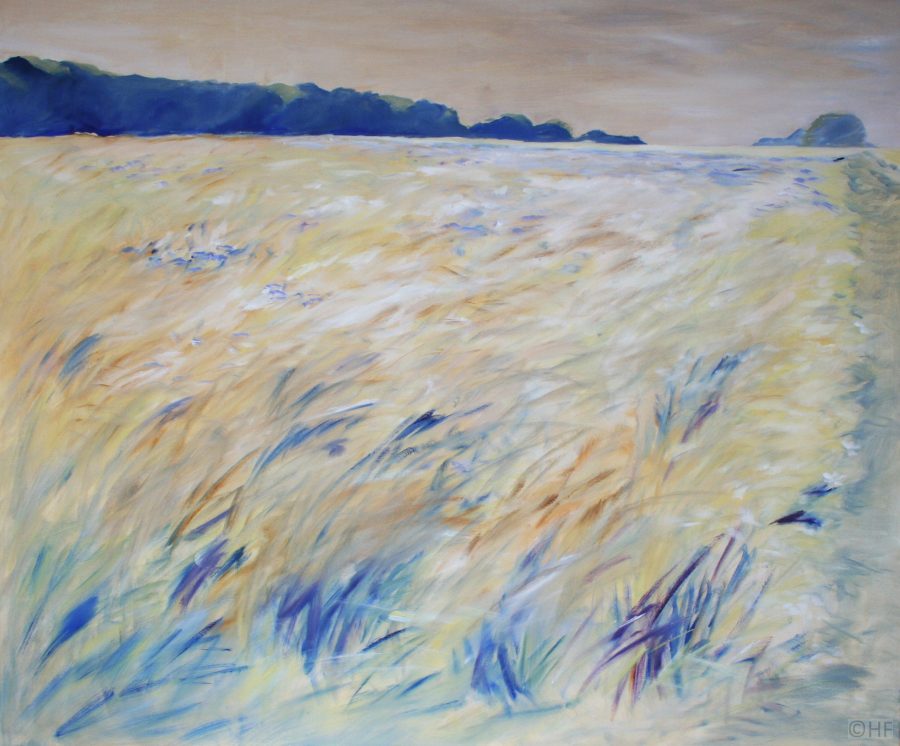
Zarte Landschaftsaquarelle,
kräftig farbige Landschaftsbilder
und – vor allem! – Albhäuser!
„Immer das Gleiche“ und doch nicht „Immer dasselbe“.
Ich werde mich bei meinen einführenden Worten auf die Albhäuser konzentrieren.
Sie bilden den umfangreichsten Teil ihres Werkes. Und dieses Motiv hat mich von
Anfang an – als ich solch ein Haus-Bild zum ersten Mal sah – angesprochen.
Warum? Was berührt mich in diesem Motiv?
Wenn ich mich befrage, meine ich, es liegt am Symbolwert des Hauses.
Das Haus
Es ist ein Symbol für Geborgenheit.
Wer sich im Haus befindet ist geschützt:
Vor Kälte und Hitze, vor Wind und Regen und
Vor den Nachstellungen anderer Menschen.
Das Haus kann auch zum Symbol werden für das ganze Leben: das Lebenshaus mit
vielen Räumen, die ich im Laufe des Lebens durchschreite.
Im Schwabenland ist das Haus auch ein Symbol dafür, dass man es geschafft hat,
dass man angekommen ist am Ziel seines Lebens, dass man Besitz gewonnen hat.
Vor einiger Zeit bin ich einmal mit HF über die schwäbische Alb gefahren.
Durch die Dörfer des Ulmer Gebiets. Temmenhausen, Scharenstetten und andere.
Ich habe auf der Fahrt einige Häuser fotografiert.
 |
Sie waren z.T. ziemlich heruntergekommen. Der Putz war abgebröckelt, man
konnte das darunterliegende Geflecht aus Weidenzweigen und Lehm sehen. Es
war also ein recht altes Haus. Daneben duckte sich ein kleinerer Schuppen mit
einem tief heruntergezogenen schützenden Dach. Und doch sah man in all der
Heruntergekommenheit seine alte Würde und Größe hindurchscheinen!
HF porträtiert die Hauser nicht.
Das heißt sie ist nicht interessiert an Alltagsdetails, an Verzierungen, an den
Spuren der Zeit, an den Menschen, die sich im Hof oder um das Haus herum
bewegen. Sie ist nicht interessiert an den Spuren des Verfalls. An Fenstern und
Türen.
Sie porträtiert die Hauser nicht, sie reduziert sie auf ihre Grundform. In der
abstrahierenden Reduktion gibt sie ihnen ihre Würde zurück oder hebt diese
hervor – so empfinde ich das.
So werden Sie transparent für das Schöne an ihnen, das Typische, das
Erhaltenswerte. Es verschwindet alles Anekdotische und Erzählerische, aus dem
Augenblick wird die Ruhe des Zeitlosen.
Die Maße der Häuser sind menschengerecht (anthropomorph), nicht in irgendeiner
Weise monumental. Das Maß ist das der Länge eines Balkens, und dieses ist
begrenzt. Begrenzt durch die mögliche Länge eines Baumes, aus dem er hergestellt
wird.
Manchmal allerdings zoomt der Blick ganz nah an das Gebäude heran, so dass man
den Umriss nicht mehr sieht. Das Haus wächst dabei zu einer fast erschreckenden
Größe.
Ein Beispiel ist das Galthaus
HF versucht mit ihrer deutlich reduzierenden Gestaltung dem Wesen dieses fast
200jährigen Gebäudes von 1823 auf die Spur zu kommen. Sie malt das Gebäude
nicht so wie es heute noch dasteht, sondern sie lässt immer mehr weg.
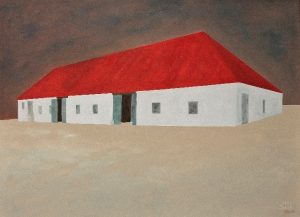 |
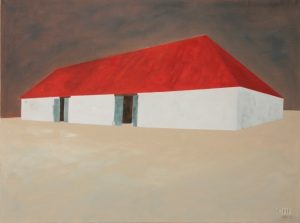 |
| Galthaus, zwischen Bitz und Albstadt |
In einer früheren Version dieses Bildes hatte sie noch sämtliche Türen und Fenster
angelegt. In der endgültigen Version hat sie nur zwei Türöffnungen stehen
gelassen.
So erst nehmen wir die Schönheit dieses Baukörpers mit seinem mächtigen Dach
wahr. Wir spüren aber auch, dass es ein Haus ist, das bergenden Raum bietet:
Heute für Schafe, früher für das noch nicht Milch gebende Vieh (mhd. galt).
Davon hat der Bau seinen Namen.
Hannelore Fehse dokumentiert nicht; sie zeigt uns etwas vom Wesen dieses
Hauses. So geschieht ein intensiver Austausch zwischen dem malenden Menschen
und den Dingen der Umgebung. Sie zu sehen und dann zu malen, ist ein Prozess
der Erkenntnis, der aktiv zu neuen Formen führt (jenseits des bloßen
‚Wiedergebens‘). (Rede in Albstadt)
HF malt nicht nur einzelne Häuser, sondern auch Gruppen von Häusern,
Straßenzüge, Ortsbilder:
HühnStubersheim, Nellingen, Aufhausen, Gosbach, Deggingen, Türkheim,
HühnLaichingen, Merklingen u.a.
Man könnte die Ortschaften und Plätze wiedererkennen, wenn man wollte, aber
das ist nicht das Ziel. Sie sind von allem schmückenden Beiwerk befreit, auf ihre
Grundform reduziert und damit konzentriert. So werden sie fast zu Mustern oder
Anhäufungen von kubischen und dreieckigen Formen. Es gibt je später desto
weniger Türen und Fenster, auch keine Schatten.
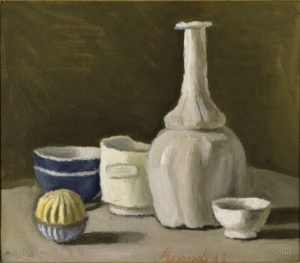
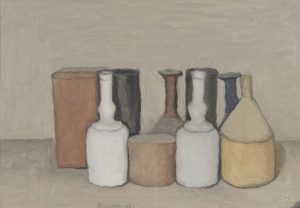
Kein Wunder, dass einige sachkundige Kritiker diese Malweise mit der von Giorgio
Morandi verglichen, der immer wieder Vasen und Flaschen in unterschiedlichen
Arrangements malte, meistens „Stillleben“ genannt.
 |
 |
Wird dabei der Gegenstand zweitrangig?
Und kommt es nur noch auf das Malerische an: die Komposition, die Farbgebung?
Ich denke, das will HF nicht, ihre Bilder sind eine Hommage an die Alblandschaft
und ihre Architektur, kein Spiel mit häuserähnlichen Formen.
Der Bezug zum konkreten Ort, zum besonderen Gebäude bleibt erhalten.
Ein Betrachter spricht von der protestantischen schmucklosen Einfachheit der
Architektur. (im Ulmer Gebiet)
Eine besondere Schönheit, die die Geisteshaltung ihrer Bewohner widerspiegelt:
Klarheit, Nüchternheit, Angemessenheit,
Konzentration auf das Wesentliche.
einfach
zeitlos
in sich ruhend
schön. …………(Zitat: Hannelore Fehse)
Herkunft
Im Norden Deutschlands, in der Uckermark ist sie geboren.
Hannelore Fehse studierte in Bonn und Tübingen: Germanistik, Geschichte
und Philosophie. Hier begegnete sie der Alb zum ersten Mal.
Von Darmstadt aus übersiedelte sie 1986 mit ihrem Mann auf die Schwäbische Alb
nach Deggingen im Filstal und näherte sich der neuen Umgebung malend.
Dabei zog gerade die Architektur der Höfe ihren Blick besonders an, die Scheunen
und Dörfer, eingebettet in die herbe Alblandschaft mit den langen Wintern.
Hier fand Hannelore Fehse eines ihrer wichtigsten Themen. (Albstadt-Rede)
Ich danke für Ihre Aufmerksamkeit
Exhibition Hannelore Fehse „Swabian Alb-Architecture and Landscape
October 21st to November 23rd 2016
Stepanek Gallery Göppingen Faurndau
Introduction: Gerlinde Hühn
|
|
| Scharenstetten in Wintertime | Merklingen |
In this exhibition, we see different aspects of Hannelore Fehses work:
Delicate landscape water colours,
strongly coloured landscapes, oil on canvas
and -first of all-Houses of the Swabian Alb
“always alike” but not “always the same”.
In my introductory words, I shall concentrate on the “Albhäuser”. They are the
most comprehensive part of her work.
This motive has appealed to me from the very first time, I have ever seen such
a house painting.
Why? Why am I touched by this motive?
If I ask myself, I think the reason is the representativeness of the house itself.
The House
It is a symbol for sheltering.
To be in a house means to be protected:
Hühn engl.From frost or heat, from wind and rain and
Hühn engl.From the harassment by other people.
The house can also turn into a symbol for the whole life, the house of life with
many rooms, which I am crossing during my life.
In the Swabian country, the house is also a symbol for achievement, for
reaching the goal of one’s life, for acquired property.
Some time ago, I was travelling with HF across the Swabian Alb.
Through villages of the Ulm Territory. Temmenhausen, Scharenstetten and
others.
During the trip, I took some pictures of houses.
|
Some of them were quite shabby. The plaster had flaked off, the willow netting
and loam underneath were visible. Clearly, it was quite an old house. Next to it
a small shed with a large sheltering roof was tucked away. And even so,
through all the deterioration it’s old dignity and greatness came through.
HF is not portraying the houses.
That means, she is not interested in trivial details, in ornaments, in the traces of
time, in the people who are moving around in the courtyard or around the
house. She is not interested in the traces of decay. In windows and doors.
She does not portray the houses, instead of that she reduces them to their
basic shape. By abstracting reduction, she is restoring or emphasizing their
dignity – that is my feeling.
In this way, they become transparent for what is beautiful, typical and worth
being conserved about them.Everything anecdotical and narrative is
disappearing, the moment is turning into the tranquillity of timelessness.
The dimensions of the houses are suitable for mankind (anthropomorphise),
not in any way monumental. The measure is the length of a beam and is
limited.Limited by the possible size of a tree from which it is made.
However, sometimes the look is zooming very closely on the building, so that
the outline is no more visible. Then, the house is growing to a nearly frightening
size.
An example is the Galthaus
By means of her reduced art, HF is trying to trace the essence of this building,
which now has been existing for nearly 200 years, dating from 1823.
She doesn’t paint the building as it is still standing there today, but she is
omitting more and more.
|
|
| Galthaus, between Bitz and Albstadt |
In an earlier version of this painting she had still displayed all the doors and
windows. In the final version, she has only kept two doorways.
It is only in this way, that we notice the beauty of this structure with its mighty
roof. But we also feel that this is a house which is offering sheltering space:
Today for sheep, in former times for not-yet-milk-giving cattle (medieval
German: galt). That is where the building got its name from.
Hannelore Fehse is not documenting; she is showing us something of the
essence of this house. In this way, an intense exchange between the painting
person and the objects in the surroundings is taking place. Seeing and then
painting them is a process of perception, actively leading to new shapes
(beyond mere reproduction) (speech in Albstadt)
HF does not only paint single houses, but also groups of buildings, streets of
houses, portraits of agglomerations:
HühnStubersheim, Nellingen, Aufhausen, Gosbach, Deggingen, Türkheim,
HühnLaichingen, Merklingen and others.
If intended, villages and places could be recognised, but that is not the aim.
They are relieved from all decorating ornaments, reduced to their basic shape
and thus concentrated. In this way, they nearly turn into samples or
agglomerations of cubic and triangular shapes. The later the less doors and
windows; no shadows as well.
No wonder, that some competent critics have compared this type of painting
with that of Giorgio Morandi, who has painted again and again vases and
bottles in different arrangements, mostly called “still lifes”.
|
|
Does in this way the object become subordinate?
Is only the quaintness any more important: the composition, the colour?
I think, that is not HF’s intention, her paintings are an homage to the landscape
of the Alb and her architecture, no play with house like shapes.
The reference to the precise location, to the particular building is preserved.
One viewer is talking of the “protestant undecorated simplicity” of the
architecture. (in the Ulm Territory)
A particular beauty, reflecting the mentality of the inhabitants:
Clarity, simplicity, adequacy
Concentration on the essentials.
Simple
Timeless
Resting in itself
Beautiful
Origin
She was born in the north of Germany in the Uckermark.
Hannelore Fehse studied German philology, History and Philosophy at the
universities of Bonn and Tübingen. It was there that she first came across the
Swabian Alb.
In 1986 she moved together with her husband from Darmstadt to the Swabian
Alb, to Deggingen in the Fils Valley and approached her new environment by
painting it. In this context, it was particularly the architecture of the farm
buildings which attracted her view. The barns and villages, nestling between
the austere landscape of the Alb with its long winter season.
Here Hannelore Fehse found one of her most important subjects.
Thank you for your attention.